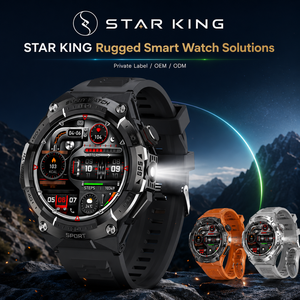
Direct factory supply with full compliance (CE, FCC, RoHS, ISO9001). Standardized hardware platforms ready for white-label deployment and custom SDK integration.
An analysis of China’s smart wearable manufacturing ecosystem for global enterprise buyers, retail brands, and B2B importers.
As the global market for fitness bands, smartwatch wearables, and biomedical tracking equipment accelerates toward an estimated global market valuation of $180 billion by 2030, China’s Pearl River Delta (specifically the Shenzhen-Dongguan hardware corridor) remains the undisputed epicenter of smart wearable production. Modern manufacturing in China has transitioned beyond simple contract assembly into high-tier ODM (Original Design Manufacturing) engineering, specializing in micro-optoelectronics, advanced surface-mount technology (SMT), biometric sensor algorithms, and militarized structural chassis fabrication.
Today's top China fitness tracker watch manufacturers operate fully integrated production facilities featuring Class 10,000 cleanrooms for optical PPG sensor bonding, automated waterproof testing rigs capable of simulating up to 10ATM static pressure, and specialized RF test chambers for Bluetooth 5.4 and dual-frequency L1+L5 GNSS calibration. For global procurement directors, partnering directly with leading Chinese exporters yields significant unit economics advantages while granting immediate access to cutting-edge biometric telemetry, extended battery life management chips, and customizable RTOS software architecture.
Deep-dive into component-level specifications, optical sensor arrays, structural sealing methods, and power optimization protocols.
The core value driver of modern fitness tracker watches lies in the accuracy of biometric telemetry. Leading Chinese manufacturers deploy multi-channel PhotoPlethysmoGraphy (PPG) sensor arrays featuring dual-green, red, and infrared LED paths paired with high-sensitivity silicon photodiodes. This hardware setup enables continuous heart rate monitoring, real-time SpO₂ blood oxygen saturation detection, and heart rate variability (HRV) stress mapping with clinical correlation rates matching standard chest straps.
Advanced models incorporate single-lead Electrocardiography (ECG) micro-electrodes co-molded directly into titanium or 316L stainless steel bezels. Combined with custom-built PTT (Pulse Transit Time) algorithms, these devices deliver real-time arterial stiffness assessments and arrhythmia screening (including atrial fibrillation detection), providing high information gain for digital healthcare providers and fitness equipment brands.
| Hardware Component | Standard Commercial Grade | Enterprise / Rugged Grade (KOSPET Level) | Procurement Value Advantage |
|---|---|---|---|
| Display Tech | TFT / IPS LCD Glass (250 nits) | AMOLED Retina / Sapphire Glass (1000+ nits) | Sunlight readability & 40% power reduction |
| Sealing Rating | IP67 (1m immersion for 30m) | IP69K + 10ATM (100m water pressure) | Suitable for diving, high-pressure jet wash |
| GNSS Chipset | Single-frequency L1 GPS | Dual-band L1+L5 (GPS, GLONASS, Beidou, Galileo) | Pinpoint tracking in canyon & urban environments |
| Enclosure Material | ABS Polycarbonate Plastic | TC4 Titanium Alloy / Stainless Steel / Zinc Alloy | Impact resistance rated to MIL-STD-810H |
| Battery Capacity | 180mAh - 260mAh (3-5 Days) | 450mAh - 880mAh (14-60 Days Standby) | Eliminates frequent charging friction for end users |
Structural reliability is another crucial differentiator. Products engineered for extreme environments undergo rigorous validation testing based on MIL-STD-810H parameters. This includes low-pressure altitude chamber testing, temperature shock endurance (-40°C to +70°C), salt fog corrosion resistance for 96 hours, and fluid contamination testing to ensure operational integrity in heavy industrial work sites or high-intensity outdoor expeditions.
Strategic insight for B2B buyers seeking to future-proof their wearable portfolio against market shifts and technical obsolescence.
1. Non-Invasive Continuous Glucose & Blood Pressure Monitoring: Over the next 3 to 5 years, procurement demand is shifting rapidly from passive activity tracking toward predictive health analytics. Leading R&D facilities in Shenzhen are integrating optical wave-guided spectroscopic sensors capable of non-invasive continuous blood glucose trend analysis and optical cuffless blood pressure measurement. Importers securing early OEM allocations on these sensor platforms will command substantial market margin advantages.
2. eSIM Integration & Independent IoT Connectivity: Standalone cellular connectivity via integrated eSIM modules is transitioning from premium consumer devices into standard fitness smartwatches. This allows remote lone-worker tracking, SOS voice emergency broadcasts, and direct cloud sync without requiring a tethered smartphone—a critical requirement for enterprise safety applications and athletic endurance sports.
3. On-Device Micro AI & Edge Computing: The migration of machine learning algorithms directly onto low-power MCU processors (such as Apollo4 Blue or Realtek chipsets) enables real-time motion classification, swim stroke identification, and predictive sleep apnea detection directly on the wrist. Edge computing reduces Bluetooth bandwidth consumption, improves user data privacy compliance (GDPR/HIPAA), and significantly extends device battery endurance.
4. Green Supply Chain & Eco-Compliant Materials: European and North American buyers are increasingly enforcing strict ESG standards across their supplier base. Top Chinese manufacturers have implemented full lifecycle eco-auditing—utilizing recycled ocean plastics for watch straps, bio-based post-consumer resin (PCR) casings, and 100% plastic-free soy-ink packaging certified by the Forest Stewardship Council (FSC).
How top Chinese smartwatch exporters maintain strict quality assurance across multi-million unit production lines.
Achieving a defect rate of under 0.15% requires strict control across every step of production. Leading manufacturing hubs adhere to a systematic 4-tier Quality Assurance framework designed to ensure zero field failures for global brands:
Incoming Quality Control (IQC): 100% inspection of incoming display panels for dead pixels, IC chip wafer level testing, and battery cell X-ray inspection to prevent internal shorts or capacity variance.
In-Process Quality Control (IPQC): Automated optical inspection (AOI) during SMT board mounting, followed by robotic dispense of waterproof structural adhesive. Every chassis undergoes helium-leak pressure testing before battery potting.
Final Quality Control (FQC): 100% burn-in testing inside dynamic temperature chambers for 48 consecutive hours. Biometric sensor validation against calibrated reference simulators ensures pulse rate accuracy within ±1 BPM and blood pressure accuracy within ±3 mmHg.
Out-going Quality Control (OQC): AQL 0.65 Major / 1.0 Minor sampling inspections evaluating drop resistance, anti-wear coating durability, wireless signal gain inside anechoic chambers, and final software firmware hash verifications prior to pallet packaging.
Addressing key technical, regulatory, and commercial queries for international importers and distributors.