China’s AMOLED Flashlight Smartwatch market combines vivid displays, compact lighting, health tracking, and connected convenience. For buyers, the challenge is identifying suppliers that deliver consistent quality rather than attractive catalog images. This guide examines leading Chinese suppliers through practical sourcing criteria, including AMOLED brightness, flashlight output, battery endurance, sensor accuracy, waterproof testing, and software stability.
A reliable supplier should explain its manufacturing process clearly. Look for documented quality controls, sample approval procedures, and repeatable production records. Factory experience matters, but it does not replace independent verification. Request product samples and inspect the screen under direct sunlight, where weak AMOLED panels quickly become noticeable. Test the flashlight in a dark room, check charging temperatures, and compare battery performance across several usage patterns.
Supplier communication also reveals important details. Professional teams should provide clear specifications, realistic lead times, and responsive after-sales support. Certifications may support trust, but buyers should verify their scope, validity, and issuing organization. Some product claims can sound impressive. They may still need careful testing.
No supplier is perfect. Differences in firmware, component availability, or quality-control discipline can affect final results. A promising sample may not represent mass production. That concern deserves attention. By comparing technical evidence, production capability, customization options, and customer feedback, importers can make more informed decisions. This overview is designed to support practical supplier evaluation, reduce avoidable sourcing risks, and identify partners capable of producing dependable AMOLED Flashlight Smartwatch models for different markets.
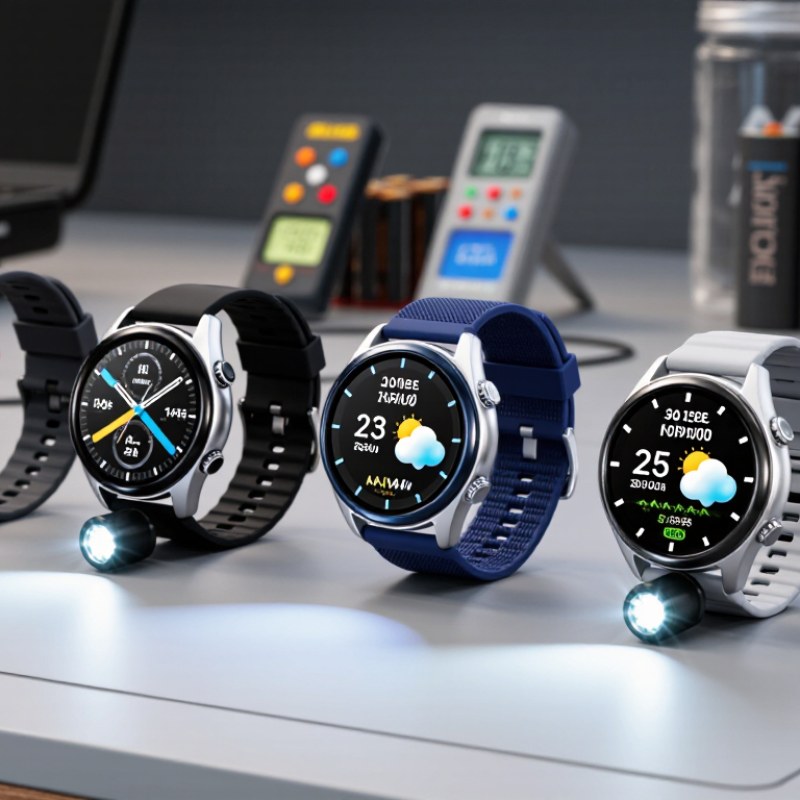
An AMOLED flashlight smartwatch combines a wearable display with a built-in LED light. AMOLED panels use self-lit pixels, producing deep blacks, strong contrast, and bright colors. This makes the screen readable in dim rooms and outdoors. The flashlight serves a different purpose. It provides a focused beam for finding keys, checking a lock, or walking beside a dark path.
Core features include adjustable brightness, a quick-access button, and low-power operation. A useful design should place the light away from the display, preventing glare on the user’s wrist. The case also needs secure sealing against sweat, rain, and dust. Buyers should check the stated water-resistance rating, not rely on vague words such as “waterproof.” Battery capacity matters too. A bright light can drain a small battery surprisingly quickly.
In practical evaluation, I would test the beam after several minutes, when heat may affect comfort. The screen should remain responsive with wet fingers, although performance can become less consistent. That weakness deserves attention. Health tracking, notifications, and emergency contact functions may add value, but they should not replace dedicated safety equipment. Reliable suppliers should provide measured brightness data, charging-cycle information, display specifications, and clear warranty terms. Sample testing is still necessary. Specification sheets can look perfect. Real wrists are less predictable.
AMOLED flashlight smartwatches use self-emitting pixels, so each pixel creates its own light. This removes the separate backlight found in many LCD panels. A full-white screen can illuminate a nearby keyhole, tent floor, or bedside table. It is useful, but not equal to a dedicated lamp.
The display driver controls brightness, color, and refresh timing. Many suppliers combine pulse-width modulation with DC dimming to reduce visible flicker at lower brightness. Flicker sensitivity varies, so testing should include slow-motion camera checks and long nighttime use. Ambient-light sensors can adjust output automatically, while touch controllers prevent accidental screen changes. Some models also use low-power display modes when the flashlight is inactive.
Thermal design matters more than appearance. High brightness increases panel temperature and battery drain within minutes. Engineers may limit brightness, reduce refresh rates, or add software cooling controls. A lithium battery, power-management chip, and efficient processor must work together without making the case uncomfortable. Sealing materials help protect the watch from sweat and rain, but heat still needs a path to escape.
In practical testing, a white AMOLED panel gives broad, soft illumination. A small LED provides a sharper beam. The choice depends on distance and purpose. No design is perfect. Some panels show uneven brightness near the edges, and automatic dimming can feel too aggressive. Reliable suppliers should measure brightness, temperature, battery loss, flicker, and water resistance across repeated tests, not only under showroom lighting.
Evaluating China-based smartwatch suppliers starts beyond polished product photos. Request registered business details, factory location, production capacity, and recent quality records. Check whether the supplier manufactures the watch or coordinates production through another facility. A live video tour can reveal testing benches, assembly lines, and storage conditions. Small details matter. Ask for sample invoices and inspection reports with sensitive information removed.
For an AMOLED flashlight smartwatch, verify the screen’s resolution, brightness, refresh rate, and burn-in controls. Confirm the flashlight’s output, battery duration, charging temperature, and water-resistance rating. Test samples in a dark room, outdoors, and during continuous operation. Use basic measuring tools instead of trusting printed specifications. Do not trust appearance alone. Review software stability, notification support, charging behavior, and companion application security. Independent laboratory testing may be worthwhile for larger orders.
Commercial terms require equal attention. Compare minimum order quantities, tooling charges, lead times, packaging options, warranty coverage, and spare-part availability. Put every technical requirement into a written specification. Include inspection points before shipment. A low quotation can conceal weaker components or expensive revisions. I once underestimated response speed, and that mistake delayed approval more than expected. Supplier evaluation is not perfectly objective. Communication records, corrective actions, and honest answers often reveal more than a showroom sample.
China Top AMOLED Flashlight Smartwatch Suppliers
Leading Supplier Capabilities and Manufacturing Standards
Reliable suppliers combine display engineering, wearable design, and disciplined factory control. AMOLED panels should deliver deep blacks, stable brightness, and readable details outdoors. A practical supplier can explain panel sourcing, touch-layer bonding, and screen calibration without vague promises.
Manufacturing quality begins with incoming inspection. Factories should check display defects, battery voltage, charging performance, flashlight output, and button response. Assembly lines need traceable production records for each batch. Functional testing should cover heart-rate sensors, Bluetooth connections, water resistance, and repeated charging cycles. Safety checks matter too, especially for lithium batteries and heat management.
Small details reveal capability.
Tips: Ask for recent test reports, sample inspection records, and clear tolerance limits. Request a production sample before approving mass manufacturing. Compare brightness, strap comfort, menu response, and flashlight consistency under indoor and outdoor conditions. Suppliers should also explain their quality process, corrective actions, and warranty handling. Be careful with impressive sample units; they may not represent regular production. A lower price can hide weaker components or less inspection time. This is where sourcing teams often need to question their own assumptions. Supplier claims are useful, but physical evidence is stronger.
| Capability Area | Typical Product Dimension | Manufacturing Capability or Standard | Recommended Verification |
|---|---|---|---|
| AMOLED Display | Active-matrix organic light-emitting diode display with individually controlled pixels. | Support for custom screen sizes, resolutions, cover-lens shapes, touch structures, and always-on display functions. OLED pixel performance should be evaluated for brightness uniformity, color accuracy, and lifetime. | Display uniformity inspection, color measurement, touch-response testing, and accelerated aging evaluation. |
| Display Brightness | Outdoor-readable designs commonly target approximately 600–1,500 cd/m² peak brightness, depending on panel size, power mode, and thermal design. | Brightness performance should be specified separately for typical brightness, high-brightness mode, and peak brightness because these values are not interchangeable. | Measure luminance with a calibrated photometer at defined display patterns and operating temperatures. |
| Touchscreen Integration | Capacitive touch input with multi-point gesture support and compatibility with protective cover glass. | Stable touch operation should be maintained with dry fingers, light moisture, gloves where required, and normal charging conditions. | Coordinate accuracy, latency, edge-sensitivity, wet-touch, glove-touch, and false-trigger testing. |
| Flashlight Module | Integrated white LED illumination module with selectable brightness levels or operating modes. | The optical cavity should provide thermal dissipation, mechanical retention, and protection against light leakage. The design should define luminous output, beam angle, runtime, and maximum operating temperature. | Measure illuminance or luminous flux, beam distribution, runtime, heat generation, and switch-cycle durability. |
| Battery and Charging | Rechargeable lithium-ion or lithium-polymer battery sized according to display, flashlight, wireless, and sensor power requirements. | Battery protection should include overcharge, over-discharge, over-current, short-circuit, and abnormal-temperature safeguards. Cell and pack evaluation should align with IEC 62133-2 where applicable. | Capacity testing, charging-cycle testing, protection-circuit testing, thermal testing, and abuse-condition evaluation. |
| Water and Dust Resistance | Common target ratings include IP67 or IP68, but the exact immersion depth and duration must be stated by the manufacturer. | Ingress protection should be designed through gasket selection, adhesive control, acoustic-port protection, button sealing, and controlled assembly tolerances in accordance with IEC 60529 testing principles. | Dust exposure and water-ingress testing using the declared IP rating and product-specific conditions. |
| Mechanical Durability | Smartwatch assemblies typically require resistance to drops, button operation, vibration, handling, and repeated charging or strap attachment. | A documented reliability plan should define drop height, impact orientation, cycle counts, vibration profile, connector durability, and post-test functional limits. | Drop, vibration, torsion, button-cycle, strap-pull, connector-cycle, and visual inspection tests. |
| PCB and SMT Production | Compact multilayer printed circuit boards with surface-mount components, fine-pitch packages, display interfaces, sensors, and power-management circuits. | Controlled solder-paste printing, component placement, reflow profiling, electrostatic-discharge protection, and traceability are essential. Solder workmanship can be assessed against IPC-A-610 criteria. | Automated optical inspection, X-ray inspection for hidden joints, reflow-profile records, electrical testing, and production traceability review. |
| Firmware and Software | Embedded firmware for display control, power management, flashlight modes, sensors, charging, notifications, and user-interface functions. | Suppliers should maintain version control, defect tracking, recovery procedures, compatibility testing, and a controlled process for firmware updates. | Functional testing, power-consumption profiling, stress testing, update recovery testing, and regression testing. |
| Quality Management | Documented quality planning from incoming materials through assembly, calibration, final inspection, and shipment. | An ISO 9001-based quality management system is a recognized benchmark for process control, corrective action, document control, and continual improvement. | Review quality certificates, process-control plans, inspection records, nonconformance reports, and corrective-action evidence. |
| Safety and Regulatory Readiness | Assessment requirements vary by destination market and may cover electrical safety, electromagnetic compatibility, radio functions, battery transport, and restricted substances. | Relevant evidence may include EMC testing, radio testing where applicable, RoHS material declarations, battery transport testing under UN 38.3, and market-specific conformity documentation. | Check complete test reports, declarations, material records, battery documentation, and product-label compliance before mass production. |
| Production Capacity | Capacity should be stated by monthly finished units, assembly lines, shift pattern, and available testing resources rather than by a generic factory claim. | A capable supplier should demonstrate pilot-run control, scalable assembly, component planning, line balancing, capacity reservation, and stable yield during ramp-up. | Audit production records, line layouts, equipment lists, yield reports, lead times, and pilot-to-mass-production transition data. |
| Traceability and After-Sales Support | Traceability should connect key components, firmware version, production date, inspection results, and shipment batch to a unique product identifier. | A mature supplier maintains serial-number control, failure analysis, warranty-return classification, replacement-part planning, and documented corrective actions. | Sample traceability records, review return-analysis reports, verify spare-parts procedures, and inspect service-response targets. |
China Top AMOLED Flashlight Smartwatch Suppliers
When purchasing from China, verify the supplier’s production experience, not only its catalog images. Request AMOLED samples with different brightness levels, accurate color performance, and responsive touch control. Confirm flashlight output, battery capacity, charging time, and operating temperature. A clear specification sheet prevents expensive misunderstandings. Ask for component sources, inspection records, and compliance documents relevant to your target market. Factory visits or live video audits can reveal storage conditions, testing equipment, and assembly discipline.
Tips: Approve a golden sample. Define inspection standards. Check every function before shipment. Use independent inspections when the order is large. Test several units from different cartons. This catches packing and assembly variation.
Quality control should cover screen pixels, dead zones, brightness consistency, button life, heart-rate readings, charging protection, and water-resistance claims. Do not accept vague promises. Set measurable limits in the purchase agreement, including defect rates and replacement procedures. In my experience, suppliers often test the main functions well but overlook accessories and user manuals. That small gap can create many support requests. I would also leave time for firmware checks, because late software changes sometimes disturb battery performance or notification stability. After-sales terms should state warranty length, response time, spare-part availability, and return responsibilities. Keep communication documented. A reliable supplier admits defects quickly, although no supplier is perfect.
It combines a self-lit AMOLED display with a built-in LED light. The screen shows deep blacks and bright colors. The LED helps find keys, check locks, or follow a dark path.
It should have adjustable brightness and quick access. The light should sit away from the display. This reduces glare on your wrist. A bright beam can drain a small battery quickly.
Check the stated water-resistance rating. Avoid trusting vague claims. The case should resist sweat, rain, and dust. Test samples carefully, because real use is less predictable.
Test the beam in a dark room and outdoors. Keep it running for several minutes. Heat may affect comfort and output. Basic measuring tools are better than printed specifications.
Yes, touch response may become less consistent with wet fingers. This weakness deserves attention. Test the screen during realistic conditions, not only on a dry desk.
Request registered business details, factory location, production capacity, and recent quality records. Ask whether production happens in-house. A live factory video can reveal testing benches and storage conditions.
Verify display resolution, brightness, refresh rate, and burn-in controls. Check flashlight output, battery duration, charging temperature, and water resistance. Also test notifications, wireless connections, and charging behavior.
Look for incoming inspection records and batch traceability. Factories should test batteries, displays, buttons, sensors, and charging cycles. Ask for corrective-action records. Attractive samples may not represent regular production.
Record minimum order quantities, tooling charges, lead times, packaging, warranty coverage, and spare parts. Add inspection points before shipment. A low quotation can hide weaker components or costly revisions.
Specification sheets can look perfect. Samples reveal brightness consistency, strap comfort, menu response, and heat behavior. Test indoor and outdoor performance. My own assumptions could still be wrong.
An AMOLED Flashlight Smartwatch combines a vivid, energy-efficient AMOLED display with practical lighting functionality and smart wearable features. Its core capabilities may include health and activity tracking, message notifications, Bluetooth connectivity, customizable watch faces, water resistance, and an integrated LED flashlight for convenient use in dark environments. Key technologies often include advanced display control, low-power processors, rechargeable battery systems, optical sensors, wireless communication modules, and durable materials designed for daily wear.
When evaluating China-based suppliers, buyers should review product specifications, engineering experience, production capacity, quality management procedures, and customization support. Reliable manufacturers should maintain consistent assembly standards, conduct inspections for display performance, battery safety, waterproofing, software stability, and flashlight brightness, and provide clear documentation. Purchasing decisions should also consider minimum order quantities, sample approval, packaging, delivery schedules, warranty terms, spare parts, technical communication, and after-sales service. A structured quality-control process and transparent cooperation can help reduce risks and support long-term product reliability.