A Diving Sports Watch is more than a timepiece with a blue dial. It is a compact instrument designed for pressure, darkness, water, and rapid decisions. The modern market reflects this practical demand. PADI’s published industry statistics report more than 30 million diver certifications worldwide. Grand View Research also identifies diving equipment as a growing global market, supported by recreational diving, training, tourism, and professional use.
Its operation is straightforward, but its engineering is not. A sealed case protects the movement from water pressure. A screw-down crown reduces leakage risks. The rotating bezel helps divers track elapsed bottom time. Luminous hands and markers remain visible near a dark reef wall. Quartz models usually provide precise, low-maintenance timing. Mechanical models offer mechanical appeal, but they require careful servicing.
Depth ratings need careful interpretation. A 200-meter rating does not mean casual use at 200 meters. Laboratory pressure tests differ from real diving conditions. ISO 6425 also considers readability, shock resistance, magnetic resistance, and condensation. The watch supports awareness. It does not replace a dive computer, depth gauge, or formal training.
Hans Wilsdorf, Rolex’s founder, once stated, “The waterproof watch should be a reality.” That sentence still explains the category’s original purpose. A serious Diving Sports Watch should resist water and remain readable under stress. Yet appearance often receives more attention than function. That is a weakness worth questioning. This guide examines how these watches work, what their specifications mean, and where marketing claims can mislead buyers.
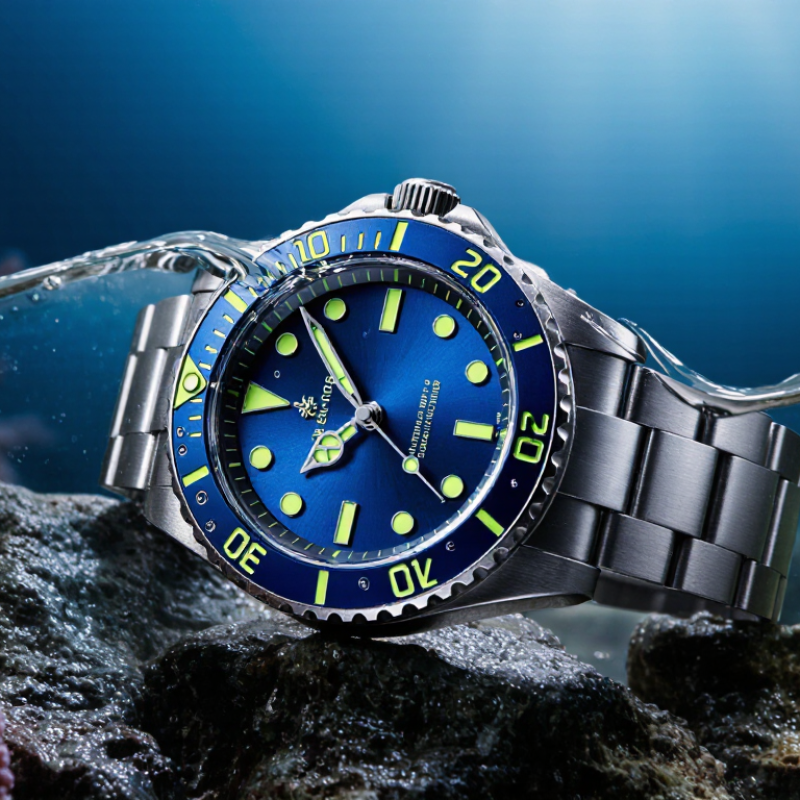
A diving sports watch is not defined by a deep-looking dial. ISO 6425:2018 sets a 100-meter minimum for a true diver’s watch. This rating reflects laboratory pressure testing, not guaranteed use at exactly 100 meters. NOAA’s Diving Manual states that seawater pressure increases by about one atmosphere every 10 meters. At 100 meters, the case faces roughly 11 atmospheres of absolute pressure, including surface pressure.
The watch works through several physical defenses. A sealed case, compressed gaskets, and a protected crown limit water entry. A unidirectional bezel helps divers track remaining bottom time. It turns only one way, so accidental movement shows less available time, not more. ISO 6425 also addresses readability, condensation resistance, magnetic resistance, shock resistance, and strap strength. These details matter in cold water, where gloves can make a small crown difficult to operate.
The number can mislead.
A “100-meter” diver’s watch should not be treated like dive equipment. Real depth, movement, temperature, impacts, and aging seals all change performance. DAN’s Annual Diving Report repeatedly emphasizes equipment maintenance and conservative decisions in diving safety. That principle applies here. A pressure test measures a controlled condition; it does not recreate every descent, current, or damaged gasket. Even the standard’s minimum can feel generous on paper.
A diving sports watch is built for quick reading in water, not decoration. ISO 6425:2018 sets a key benchmark: the time must remain readable in darkness from 25 centimeters. That distance is practical. A diver can hold the wrist close while checking air time or decompression information.
The distance is small. Yet visibility is difficult. Water absorbs red wavelengths early, according to NOAA Ocean Service guidance. Blue-green surroundings can therefore weaken ordinary dial colors. Strong contrast, broad hands, and luminous markers become essential. A rotating timing bezel also helps measure a planned interval without mental arithmetic. Its markings should remain distinct, even through a mask and low visibility.
A realistic test uses gloved hands, dim light, and a wet crystal. ISO 6425:2018 evaluates more than readability, including water resistance and resistance to external stresses. However, compliance does not guarantee effortless reading for every diver. Scratches, bubbles, fogging, and poor wrist position can still interfere. My cautious view is simple: laboratory legibility is only the starting point. The watch must communicate quickly when the water is cold, visibility drops, and attention is divided. That is where design quality becomes measurable.
A diving sports watch is a compact timing instrument built for underwater conditions. Its unidirectional bezel helps estimate remaining dive time without batteries or electronics. Before descent, the diver aligns the bezel’s zero marker with the minute hand. If the plan allows 45 minutes, the hand shows 18 minutes elapsed after 18 minutes underwater. About 27 minutes remain.
The bezel only turns counterclockwise. This detail matters. If a bump moves it, the displayed time becomes shorter, not dangerously longer. That simple failure direction supports the safety principle behind ISO 6425:2018, which specifies requirements for diver’s watches, including a protected timing system and clear minute indications. The bezel measures elapsed time, however; it does not calculate decompression limits, air supply, or nitrogen loading.
NOAA’s Diving Manual states that seawater pressure increases by roughly one atmosphere every 10 meters. Conditions can change quickly. A deeper descent, colder water, or slower swimming may consume gas faster than expected. The bezel cannot see those variables. DAN’s Annual Diving Report also treats equipment use as one part of a broader risk-control process, not a substitute for training and planning. That distinction is easy to forget. I have found the physical click of each bezel position reassuring, but reassurance can become overconfidence. Check the bezel, depth, gas, and planned limits together. A watch records the past. It does not predict the next problem.
A diving sports watch is built to keep water outside while pressure rises underwater. Its case forms a rigid barrier around the movement, dial, and hands. The seals do the quieter work. Usually made from rubber or similar elastic materials, they sit around the crystal, caseback, crown, and pushers. When correctly fitted, they fill tiny gaps that metal parts cannot close alone.
ISO 6425 gives this protection a measurable framework. A watch marked for 200 metres is tested at 125% of its stated pressure, equivalent to 250 metres in the pressure test. The case is exposed to controlled pressure, then checked for leakage, condensation, and proper operation. The test is not a theatrical plunge into the ocean. It is a repeatable laboratory procedure. Small details matter, including crown alignment, gasket condition, and caseback tightness.
The rating is helpful, not magical. Salt, heat, ultraviolet light, and repeated crown use can age seals. A watch may pass testing when new, yet become less secure years later. That assumption is wrong. Water resistance is not permanent. Professional pressure testing can reveal problems before moisture reaches the movement. Even then, real diving adds movement, impacts, cold water, and imperfect handling. The ISO test supports confidence, but careful maintenance still decides whether the case remains dependable.
| Data Dimension | Typical Specification or Requirement | How It Works Underwater | Practical Significance |
|---|---|---|---|
| Primary purpose | A diver’s watch is designed to remain functional and readable during underwater use, with a stated water-resistance rating and diving-oriented controls. | The case limits water entry while the dial, hands, and timing bezel provide elapsed-time information. | It is a timing and monitoring instrument, not a substitute for a dive computer, depth gauge, or decompression table. |
| ISO 6425 water-resistance test | A watch claiming conformity with ISO 6425 is tested against water pressure above its marked rating; the commonly cited pressure test uses 125% of the rated pressure. | The case is exposed to controlled pressure in a test apparatus, then checked for leakage and functional problems according to the applicable standard and test procedure. | The test provides a safety margin, but it does not mean the watch should routinely be used at the test pressure or at the exact marked depth. |
| Pressure example | For a 200 m rating, the nominal gauge pressure is approximately 20 bar; 125% corresponds to approximately 25 bar gauge pressure. | Pressure compresses the case components and loads the crystal, case back, crown, pushers, and gaskets from all directions. | Depth ratings are laboratory ratings. Movement, temperature, motion, salt water, aging seals, and impact can reduce real-world safety. |
| Case-back gasket | A circular elastomer gasket is seated between the case and the case back; common gasket families include nitrile rubber, fluorocarbon rubber, and silicone. | The gasket is compressed against mating surfaces, creating a continuous barrier that prevents water from reaching the movement. | A cut, flattened, contaminated, incorrectly sized, or aged gasket can cause leakage even when the case appears undamaged. |
| Crown and crown-tube seals | Water-resistant crowns usually use one or more internal gaskets; screw-down designs add threaded mechanical compression but still depend on intact seals. | The crown must be fully closed so its gasket remains correctly compressed against the crown tube or internal sealing surfaces. | Operating or opening the crown underwater can create a direct path for water entry and should be avoided. |
| Chronograph pushers | Pushers require dedicated seals and are not automatically suitable for underwater operation simply because the watch has a high water-resistance rating. | Pressing a pusher can move sealing parts or open a passage through the case if the design is not specifically engineered for underwater actuation. | Unless the instructions explicitly allow it, chronograph pushers should remain untouched during immersion. |
| Crystal and crystal gasket | The crystal may be mineral glass, sapphire crystal, or another suitable material, secured by a precision-fitted gasket or retaining system. | External water pressure pushes the crystal toward its seat; the gasket prevents water from passing around the crystal edge. | A chip, crack, loose crystal, or damaged gasket can compromise water resistance and should be inspected before diving. |
| Unidirectional bezel | A rotating bezel with one-way movement is commonly used to set a reference point for elapsed dive time. | If the bezel is accidentally turned during a dive, it can move only toward a shorter indicated time, reducing the risk of unknowingly extending the planned interval. | The diver aligns the bezel marker with the minute hand at the start of a timed activity and reads elapsed minutes from the scale. |
| Legibility and lume | Diving-watch designs use high-contrast markings and luminous elements on the hands, hour markers, and bezel reference point. | Photoluminescent material stores light and emits it in darkness; visibility gradually decreases over time. | Legibility is important in low-light water, but the diver should not rely on lume as a replacement for a complete timing and dive plan. |
| Helium-release valve | A helium-release valve is an optional feature intended primarily for certain saturation-diving environments; it is not required for every diving watch. | During decompression, accumulated helium inside the case can be released through a pressure-activated or manually operated valve. | Most recreational divers do not need this feature; its presence alone does not prove that a watch meets ISO 6425. |
| Salt-water resistance | Relevant testing can include exposure to a salt-water solution, followed by inspection for corrosion or impaired operation. | Salt residue can remain around the bezel, crown, case back, and bracelet, where it may accelerate corrosion or affect moving parts. | Rinsing with fresh water after use and drying the watch helps remove salt deposits, provided the case is intact and the crown is closed. |
| Maintenance interval | Water resistance is not permanent. Gaskets, crown components, crystal seals, and case interfaces should be inspected periodically and after significant impact. | Elastomer seals can harden, shrink, flatten, or lose elasticity because of time, heat, chemicals, ultraviolet exposure, and repeated movement. | A pressure or water-resistance test after service is the reliable way to verify sealing; visual inspection alone cannot confirm performance. |
| Meaning of the depth marking | A marking such as 100 m, 200 m, or 300 m describes a tested pressure category, not a universal guarantee for every type of diving at that depth. | The watch responds to pressure, temperature, movement, and mechanical stress in ways that may differ from a static laboratory test. | Use the manufacturer’s instructions, keep all controls closed, and have the watch tested after opening the case or experiencing a strong impact. |
A diving sports watch is a pressure-resistant instrument, not merely a large watch with bright markers. Below water, pressure increases by roughly one atmosphere every 10 metres, according to the NOAA Diving Manual. ISO 6425:2018 requires a diver’s watch to pass water-resistance, condensation, shock, magnetic, and visibility tests. These tests matter because a watch rated for 200 metres is not automatically suitable for every dive. The rating describes controlled testing, not unlimited real-world use.
The crown is a frequent weak point. A screw-down crown compresses gaskets against the case, but damaged threads or sand can compromise sealing. Crown guards may reduce impact risk, though they cannot replace maintenance.
The strap must remain flexible in cold water. Rubber and fabric straps usually handle saltwater well, but buckle corrosion can still create a failure. A metal bracelet offers adjustment, yet wetsuit compression may leave it loose. I have found this easy to overlook.
Movement performance below water depends on stable sealing and shock control. Mechanical movements can lose or gain time after impacts, while quartz movements usually offer steadier daily accuracy. ISO 6425 testing includes functional checks under pressure, but aging seals deserve more attention than marketing numbers.
Tips: Rinse the watch with fresh water after each dive. Check the crown before entering water. Replace gaskets during scheduled servicing. Do not test an old watch by diving with it. A pressure test is cheaper than a flooded movement.
ISO 6425:2018 sets a 100-meter minimum rating for a diving sports watch. This rating comes from controlled pressure testing. It does not guarantee safe use at exactly 100 meters.
Seawater pressure rises about one atmosphere every 10 meters. At 100 meters, pressure reaches roughly 11 atmospheres, including surface pressure. Movement, impacts, temperature, and aging seals can reduce performance.
A rigid case surrounds the movement, dial, and hands. Gaskets seal the crystal, caseback, crown, and pushers. A protected crown helps limit water entry.
It helps measure remaining bottom time. The bezel turns in only one direction. If it moves accidentally, it shows less time remaining, not more.
ISO 6425:2018 requires readability in darkness from 25 centimeters. Broad hands and bright markers improve quick reading. Wet glass, scratches, bubbles, or poor wrist position can still interfere.
Water absorbs red wavelengths early. Blue-green surroundings can weaken familiar colors. Strong contrast and clear luminous markings become more useful.
A watch rated for 200 meters is tested at 125% of its stated pressure. That equals a controlled test at 250 meters. Inspectors then check leakage, condensation, and operation.
No. Salt, heat, ultraviolet light, and repeated crown use can age them. Professional pressure testing can find weak points before moisture reaches the movement.
No. It supports timing and underwater readability, but it is not complete diving equipment. Conservative decisions and regular maintenance still matter. I may sound overly cautious, but water is unforgiving.
A Diving Sports Watch is designed to remain reliable, readable, and secure in demanding underwater conditions. To meet the ISO 6425 standard, it must generally provide water resistance to at least 100 meters, while maintaining clear visibility at the required 25-centimeter reading distance. Its dial and hands use strong contrast and luminous markings so divers can check the time in low-light environments. A unidirectional rotating bezel adds an important safety function: by aligning its marker with the minute hand at the beginning of a dive, the wearer can track remaining dive time without accidentally extending it if the bezel is moved.
Inside the case, gaskets and carefully protected openings help prevent water from entering. ISO testing includes exposure to pressure equivalent to 125% of the stated rating, checking both water resistance and operational stability. Crowns, straps, and the movement must also perform reliably below water, resisting pressure, moisture, and accidental impacts. Together, these features make the Diving Sports Watch a practical timing instrument rather than merely a conventional timepiece.