
Choosing the 2026 best Long Battery Outdoor Watch requires more than reading the largest battery number. Outdoor buyers need dependable navigation, readable screens, accurate health tracking, and stable performance in rain, cold, and remote areas. A watch may claim weeks of endurance, yet frequent GPS use can reduce that figure sharply. Battery claims need context.
Industry data shows why this category deserves careful research. Counterpoint Research reported that global smartwatch shipments declined 7% year over year in 2024, marking the market’s first annual decline. This suggests buyers are becoming more selective about practical value, not simply adding another screen to their equipment. Meanwhile, IDC’s Worldwide Quarterly Wearable Device Tracker continues to monitor strong global demand for wearable devices, although its broader category includes fitness trackers and smartwatches. Grand View Research also forecasts continued growth in the global smartwatch market, but estimates vary because companies define the category differently.
This guide compares battery capacity, real-world GPS endurance, charging speed, satellite support, durability, and software reliability. A runner may need reliable route guidance for a twelve-hour trail day. A mountaineer may prioritize cold-weather battery behavior and emergency communication compatibility. A frequent traveler may prefer solar assistance, offline maps, and fewer charging cables. Real life differs.
The evaluation also considers evidence from manufacturer specifications, independent reviews, and established market research. No ranking is perfect. User habits, weather, wrist fit, and screen settings change results. Therefore, the best Long Battery Outdoor Watch is not automatically the model with the longest advertised runtime. It is the model that keeps essential functions available when the journey becomes longer, colder, and less predictable.
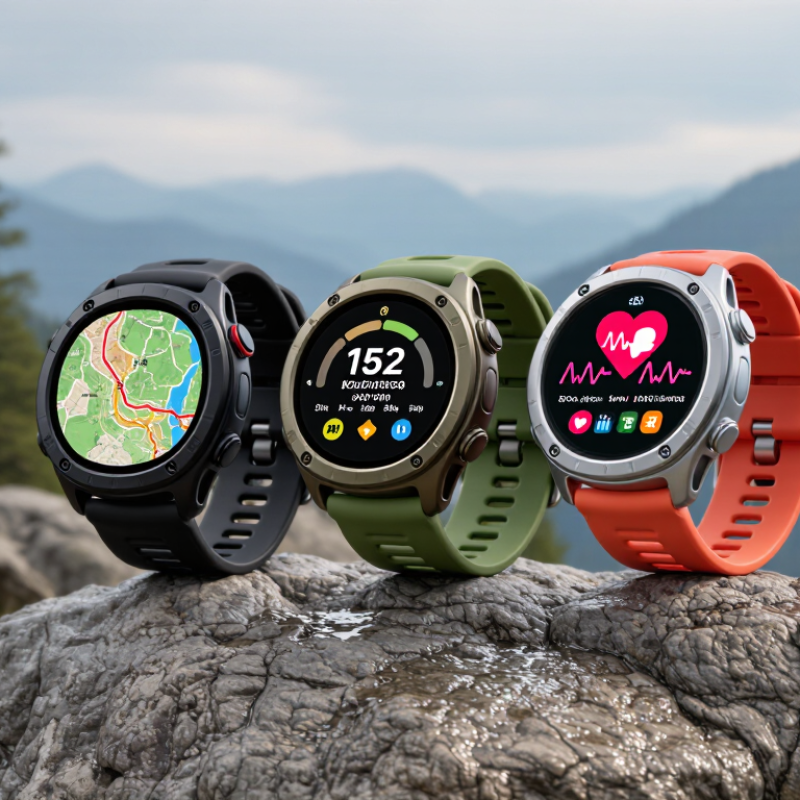
A long-battery outdoor watch must do more than display a large number of days. For global buyers, it should remain dependable across climates, time zones, and travel conditions. Battery performance should be tested with location tracking, heart-rate monitoring, notifications, and screen use enabled. Manufacturers often quote laboratory results. Real use is less predictable.
Weather changes quickly. A hiker may start in tropical heat and finish in cold mountain air. Battery chemistry can react differently to temperature, while continuous navigation increases power demand. A reliable model should provide clear battery estimates and a practical low-power mode. Solar assistance can help, but it should not replace a rechargeable battery plan. That detail matters.
Global suitability also depends on comfort and service access. The watch should support multiple satellite systems, accurate time synchronization, readable maps, and common charging standards. A strong case, sealed buttons, and a scratch-resistant display are useful during rain, dust, and accidental impact. Materials should be assessed against recognized water-resistance and durability testing, not vague marketing claims. Buyers should check local warranty coverage before ordering internationally. I would not assume every advertised feature works equally well in every country. Regional map data, network services, and emergency functions may differ. It is not enough. A long-lasting watch still needs trustworthy measurements, simple controls, and a charger that can be replaced without difficulty. Expect some compromise between battery life, weight, screen brightness, and tracking accuracy. That trade-off deserves honest attention.
Battery life depends on more than the advertised capacity. Modern outdoor watches often use lithium-ion cells, low-power processors, and adaptive display controls. Transflective screens usually consume less energy in bright sunlight. AMOLED screens look sharper, but continuous viewing can drain power faster.
In normal watch mode, many outdoor models may run for 7 to 21 days. Continuous GPS tracking commonly lasts 20 to 60 hours. Expedition modes can extend operation for several weeks by recording locations less often. Solar charging may add useful hours during long, bright days, but it rarely replaces regular charging. Cloud cover, cold temperatures, navigation, music, and frequent notifications reduce runtime. These figures are estimates, not promises. Real trails are messier.
Tips: Test the watch before a long trip. Enable battery-saving GPS settings, reduce screen brightness, and carry a small charging cable. Check performance around 0°C, because cold can temporarily reduce battery output. Also compare charging standards when buying internationally. A device that charges slowly from a weak power source may become inconvenient. Battery claims need context. That part is easy to overlook. A reliable choice should offer clear test conditions, replaceable straps, accurate battery percentages, and stable software. I would also question extremely high runtime claims unless independent testing explains the recording interval, screen use, and temperature.
A long-battery outdoor watch should support real movement, not only impressive laboratory numbers. The Outdoor Industry Association’s 2024 report counted 175.8 million U.S. outdoor participants in 2023. That growth reflects varied needs, from dusty trails to crowded airports. For hiking, look for reliable GPS, route-back navigation, a readable display, and physical buttons. Touch controls can fail with rain or gloves. Battery claims also need caution. Continuous GPS tracking, cold temperatures, and bright screens can reduce runtime sharply. Real use is messier.
Travel demands different strengths. Multi-constellation satellite positioning can improve tracking near tall buildings and narrow valleys. A barometric altimeter helps hikers notice elevation changes. A compass remains useful when digital maps become confusing. For extreme environments, check the stated operating temperature, impact resistance, and water protection. IEC 60529 ratings describe dust and water ingress, but they do not guarantee safe diving. ISO 22810 focuses on watch water resistance. These standards help, yet they cannot replace field testing. I once trusted a battery percentage too much. It dropped quickly after a cold mountain morning.
Tips: Choose a watch with at least several days of normal use and a low-power expedition mode. Test navigation before leaving cellular coverage. Save offline maps and carry a paper route card. Compare measured runtime, not only marketing estimates. Read independent reviews from hikers using similar temperatures. The GSMA Mobile Economy report highlights expanding mobile connectivity, but remote trails still create coverage gaps. A watch is useful there, not magical. Recheck the route.
A practical specification guide for comparing long-battery outdoor watches without relying on company or brand data. Actual battery life varies with temperature, screen settings, satellite mode, mobile connectivity, and sensor use.
| Evaluation Dimension | Recommended Minimum | Strong Target for 2026 | Practical Outdoor Benefit | What Buyers Should Verify |
|---|---|---|---|---|
| Battery Life in Smartwatch Mode | At least 10 days under normal notification and activity use | 14–30 days, depending on display and sensor settings | Reduces charging frequency during long trips, business travel, and multi-day hikes. | Check whether the estimate includes continuous heart-rate monitoring, notifications, and sleep tracking. |
| Battery Life with Continuous GPS | At least 20 hours | 30–60 hours in standard multi-GNSS mode | Supports full-day hikes, trail races, trekking stages, and long-distance navigation. | Compare standard GNSS, all-systems GNSS, dual-frequency GNSS, and screen-on figures separately. |
| Expedition or Low-Power Tracking Mode | At least 5 days of periodic location tracking | 10–30 days, depending on tracking interval and conditions | Useful for remote travel when regular charging is difficult or unavailable. | Confirm the location update interval, route accuracy, and whether notifications are disabled in this mode. |
| Solar-Assisted Charging | Optional, with clearly stated charging conditions | Solar assistance that extends runtime during prolonged outdoor exposure | Can slow battery drain in sunny environments, especially during camping and trekking. | Solar performance is supplementary; verify the manufacturer’s light-intensity test conditions rather than assuming unlimited runtime. |
| Satellite Positioning | GPS plus at least two additional global or regional satellite systems | Multi-GNSS with optional dual-frequency positioning | Improves route tracking reliability in forests, valleys, and dense urban areas. | Look for support for systems such as Galileo, GLONASS, BeiDou, or QZSS, and check whether dual-frequency mode reduces battery life. |
| Offline Maps and Navigation | Breadcrumb route navigation with downloadable routes | Offline topographic maps, turn guidance, elevation data, and route recalculation | Provides navigation when cellular service or roaming data is unavailable. | Confirm map coverage for the destination country, update policy, storage capacity, and map licensing requirements. |
| Water Resistance | 5 ATM water rating | 10 ATM rating for frequent surface-water use | Handles rain, sweat, river crossings, and swimming when used within the stated rating. | Water resistance is not permanent; inspect seals after impact and follow limits for diving, hot water, and high-pressure water. |
| Dust and Environmental Protection | Sealed construction with a published ingress-protection rating | IP68-level dust and water protection, where formally specified | Helps protect the watch from dust, sand, mud, and heavy rain. | IP ratings describe specific laboratory conditions and do not replace care instructions for saltwater, chemicals, or impact. |
| Shock and Temperature Resistance | Published testing for vibration, shock, and temperature variation | Testing aligned with relevant MIL-STD-810H methods or equivalent documented procedures | Improves confidence in cold-weather trekking, hot climates, vehicle travel, and rough handling. | Check which test methods were completed; a standard reference does not automatically mean every test category was passed. |
| Operating Temperature | Approximately −10°C to 45°C for normal operation | Approximately −20°C to 50°C, subject to the device specification | Supports winter travel, high-altitude routes, desert trips, and rapid climate changes. | Battery capacity and charging performance decline in cold conditions; keep the device insulated when temperatures are very low. |
| Display Visibility | Readable in direct sunlight with adjustable backlight | Reflective or memory-in-pixel display with strong outdoor contrast and optional touch control | Improves readability on bright trails while helping preserve battery life. | Check night readability, glove operation, wet-screen behavior, and whether always-on display significantly reduces runtime. |
| Physical Controls | At least two dedicated buttons | Multi-button control with a lock function and glove-friendly operation | Allows reliable operation in rain, snow, cold weather, or when touchscreen use is inconvenient. | Test button size, accidental-press resistance, and access to navigation and emergency functions. |
| Health and Safety Sensors | Optical heart-rate monitoring, pulse-oximetry capability, compass, and barometric altimeter | Heart-rate alerts, blood-oxygen trends, skin-temperature sensing, storm alerts, and abnormal-altitude notifications | Supports pacing, elevation tracking, weather awareness, and personal trip monitoring. | These sensors are for wellness and navigation support, not medical diagnosis; accuracy varies with fit, motion, skin contact, and altitude. |
| Navigation Sensors | 3-axis compass and barometric or GPS-based elevation | Calibrated compass, barometric altimeter, gyroscope, and route elevation profiles | Improves heading, ascent, descent, and terrain-awareness data. | Barometric altitude can change with weather pressure; recalibration may be required during long trips. |
| Emergency and Communication Tools | Live location sharing through a paired phone | Incident detection, emergency contacts, SOS support, and optional satellite communication through a compatible service | Provides an additional safety layer during solo hiking and remote travel. | Emergency features may require a phone, cellular coverage, subscription, regional availability, or unobstructed sky view. |
| Global Travel Compatibility | Bluetooth connectivity with broad smartphone compatibility | Multi-region language, time-zone, map, GNSS, and notification support | Reduces compatibility problems when crossing borders or changing mobile networks. | Check smartphone operating-system requirements, local map availability, payment features, and regional emergency-service limits. |
| Weight and Wearability | Preferably below 90 g including the standard strap | Approximately 50–80 g with a durable, replaceable strap | Reduces wrist fatigue during sleep, running, climbing, and extended trekking. | Compare case thickness, lug design, strap comfort, and balance rather than weight alone. |
| Repairability and Long-Term Use | Replaceable strap and documented software support | Replaceable accessories, clear warranty coverage, regular firmware updates, and service availability in the buyer’s region | Extends useful life and lowers ownership risk for international buyers. | Verify warranty region, battery-service options, replacement strap availability, and update support period before purchase. |
Buying note: Battery figures are comparable only when tested under the same settings. Continuous dual-frequency positioning, music playback, bright always-on displays, low temperatures, frequent notifications, and cellular or satellite communication can substantially shorten actual runtime.
2026 Best Long Battery Outdoor Watch for Global Buyers?
Global compatibility starts with navigation, not marketing. A strong outdoor watch should support GPS, Galileo, GLONASS, BeiDou, and QZSS. Multi-band reception can improve positioning near tall buildings and steep rock faces. However, accuracy still depends on sky visibility, weather, and body movement. The U.S. National Institute of Standards and Technology notes that satellite positioning performance varies with signal conditions. Battery estimates also need careful reading. Continuous tracking, cold temperatures, and frequent notifications can reduce endurance sharply.
Connectivity is equally important for international buyers. The GSMA Mobile Economy 2024 report recorded 4.7 billion mobile internet users globally in 2023. Yet cellular coverage remains uneven across regions. Check supported LTE bands, eSIM availability, roaming agreements, and emergency-service restrictions before purchase. Regional radio certification also matters. A watch approved in one market may need different testing elsewhere. This detail is easy to miss.
Tips: Choose satellite-only tracking for remote trips. Select cellular models only after checking local bands. Treat IP68 as an IEC 60529 ingress rating, not unlimited waterproofing. For harsh use, review documented IEC or MIL-STD-810H test conditions. “Rugged” is not a measurement. I would also test navigation under trees before trusting it in a remote valley. Reports and specifications help, but real terrain can expose weaknesses.
Choosing the best long-battery outdoor watch in 2026 requires more than reading the advertised battery number. I compare battery life under realistic conditions, including GPS tracking, heart-rate monitoring, navigation, and cold weather. A watch claiming 30 days may last far less with daily route recording. Test conditions matter.
Start with your usual activity. Hikers may need accurate GPS, offline maps, elevation data, and emergency location sharing. Long-distance travelers should check charging standards, language support, satellite coverage, and local service access. A clear display helps in bright sunlight, while physical buttons remain useful with wet or gloved hands. Touch controls can become frustrating.
Check battery modes carefully. Some conserve power by reducing GPS accuracy or disabling sensors. That trade-off may be acceptable, but it should be clearly explained. Look for replaceable straps, water resistance ratings, scratch protection, and software update policies. Independent reviews and repair information are more reliable than promotional claims.
I also test comfort over several days. A heavy case can feel tiring during sleep or climbing. A smaller battery may suit daily users better than a large, uncomfortable design. My own comparisons are imperfect because weather, signal strength, and settings change results. Still, recording each test setting makes the decision more honest. Beware of impressive figures without test details.
Many models last 7 to 21 days in basic watch mode. Real usage varies.
Continuous tracking often lasts 20 to 60 hours. Navigation, bright screens, and notifications reduce this time.
Usually, no. Solar assistance can add useful hours under bright skies, but rechargeable power remains necessary.
Around 0°C, battery output may temporarily decrease. Carry a small charging cable on cold trips.
Lower screen brightness and use longer tracking intervals. A low-power mode can extend operation for several weeks.
Support for multiple satellite systems improves positioning across regions. Accuracy still depends on sky visibility and terrain.
No. Check local network bands, digital SIM support, roaming access, and emergency-service limits before buying internationally.
Look for documented water-resistance and impact testing. A sealed case helps, but “rugged” alone proves very little.
Check recording intervals, screen use, temperature, and notification settings. Laboratory numbers can look impressive. Real trails are messier.
Longer battery life may mean a heavier case, dimmer display, or less frequent tracking. I would not ignore that trade-off.
In 2026, a Long Battery Outdoor Watch should do more than simply last for days. It must provide dependable power in real outdoor conditions, where cold temperatures, weak signals, and frequent GPS use can reduce battery life. Modern battery technologies, power-saving modes, solar assistance, and efficient display systems can help users balance extended runtime with accurate activity tracking. For global buyers, practical performance matters more than advertised laboratory figures, so expected battery life should be considered across hiking, travel, navigation, and emergency situations.
A suitable watch should combine multi-system GPS, reliable connectivity, water and dust resistance, impact protection, readable displays, health and fitness tracking, and useful navigation tools. Global compatibility also includes support for different regional satellite systems, charging standards, language settings, and durable materials suited to varied climates. To choose the best option, compare real-world battery performance, GPS accuracy, comfort, safety features, software usability, repair support, and total value. The ideal Long Battery Outdoor Watch offers a balanced design that remains dependable during everyday adventures and demanding journeys.